Browse Depth Notes
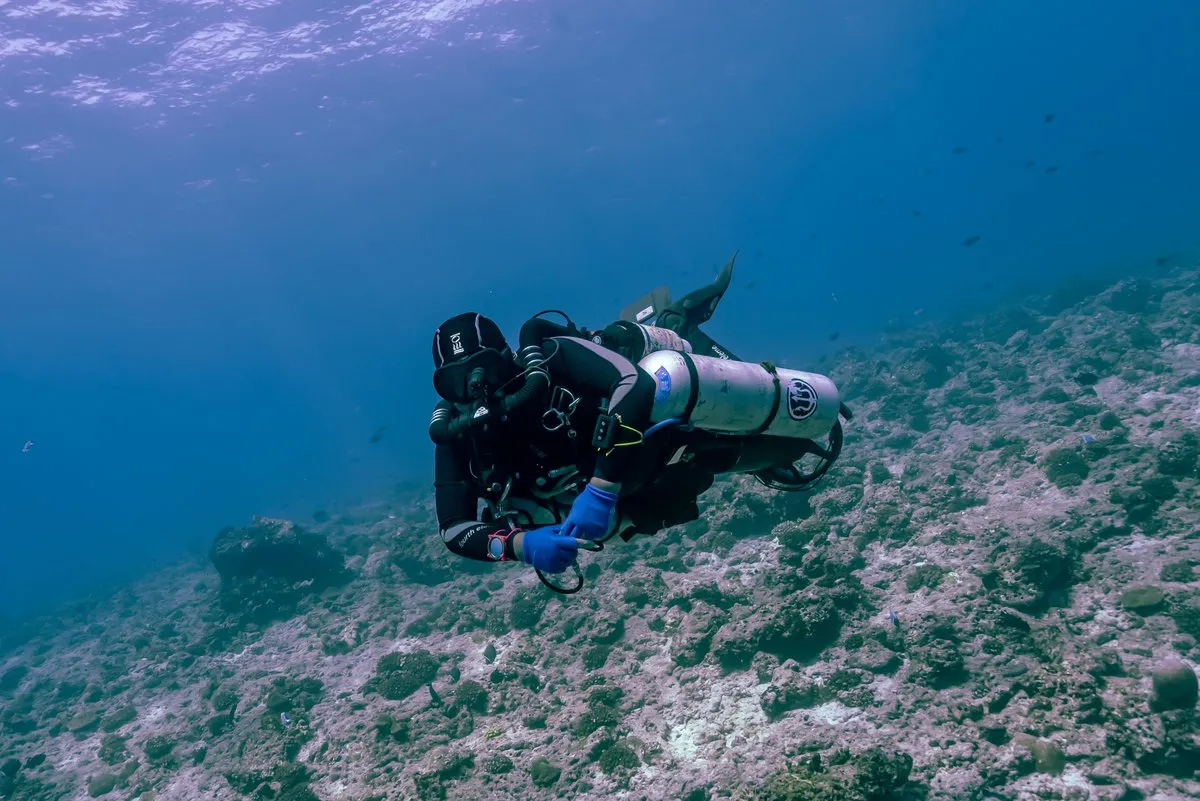
Rebreather Diving (CCR): How It Works, and Is It Dangerous?
Recycle your breath instead of dumping it: how a CCR works, and what makes it unforgiving.
June 16, 2026 · 5 min read
What a rebreather is
On open circuit, every breath you exhale leaves as bubbles, carrying away most of its oxygen unused. A rebreather keeps that gas in a closed loop and reconditions it: it removes the carbon dioxide and replaces the oxygen your body burned. A closed-circuit rebreather (CCR) recirculates nearly all of it and holds the oxygen at a chosen level for the whole dive.
That single change, recycling instead of dumping, is why a CCR can turn a deep dive that would empty several large cylinders on open circuit into one that uses a few litres of oxygen.
How a CCR works
You breathe around a loop:
- Mouthpiece (DSV/BOV) opens to the loop, and can usually switch to open-circuit bailout in an instant.
- Counterlungs are the breathing bags you draw from and exhale into.
- The scrubber is a canister of absorbent (sofnolime) that chemically removes the CO2 you breathe out.
- Oxygen cylinder feeds in O2 to replace what your body metabolised.
- Diluent cylinder (air or trimix) adds inert gas on descent to keep the loop filled.
- Oxygen sensors (usually three, with voting logic) measure the partial pressure of oxygen so the unit can hold it at a setpoint.
How the loop works · KISS Sidewinder mCCR
Gas leaves your mouthpiece (DSV), runs down the exhale counterlung and through the CO₂ scrubber, then up the inhale counterlung past the three oxygen cells and back to you. Oxygen is injected as your body uses it; diluent is added on descent. Adapted from our KISS Sidewinder MOD1 course.
Two flavours differ in how they keep the oxygen level steady. An electronic CCR (eCCR) uses a controller and a solenoid to inject oxygen automatically to a setpoint. A manual CCR (mCCR) feeds a steady trickle of oxygen through a fixed orifice and the diver tops it up by hand, watching the gauge. The KISS Sidewinder we teach is a sidemount mCCR: simple, robust, and you fly one chosen oxygen level for the dive.
Why divers use them
- Gas efficiency. You consume oxygen at roughly your metabolic rate no matter how deep you are, so a CCR sips gas where open circuit gulps it. This is what makes long, deep dives practical.
- Better decompression. Holding a high, constant oxygen level keeps the inert-gas gradient working in your favour, so you off-gas faster and spend less time on decompression.
- Silence and no bubbles. Nothing startles fish or wrecks a photo like a curtain of bubbles. A CCR is near-silent, which is why underwater photographers and scientists love them.
- Warm, moist gas. Rebreathed gas is warm and humid, so you lose less heat and your airways stay comfortable on long dives.
Is rebreather diving dangerous?
Honestly: it has more failure modes than open circuit, and the dangerous ones are quiet. Three things hurt people, and a CCR diver manages all three on every dive:
- Too little oxygen (hypoxia). If the oxygen level in the loop falls too low, you can lose consciousness with no warning at all. Most common on the surface and at the start of a dive.
- Too much oxygen (hyperoxia). Push the oxygen level too high and you risk a CNS oxygen-toxicity seizure underwater, which is usually fatal without a bailout.
- Carbon dioxide build-up (hypercapnia). When the scrubber is exhausted or floods, CO2 climbs: headache, panic, and eventually unconsciousness.
None of this makes a rebreather a bad idea. It makes it a tool that rewards training, checklists, and discipline, and punishes complacency. Every CCR course is really teaching you to monitor those three numbers and to bail out to open circuit the moment something is wrong.
Is it for you?
A rebreather is not the next step after your first course. It rewards a solid open-circuit foundation, comfortable buoyancy and gas habits, and usually some nitrox or technical experience first. Then it opens up dives that open circuit simply can't reach.
The best way to know is to try one. We run KISS Sidewinder CCR training for divers travelling to learn the unit properly. Get in touch and tell us your experience level.
References
- Mitchell SJ, et al. Rebreather Forum 4 Consensus. RF4 Proceedings, 2024.
- Bozanic JE. Mastering Rebreathers, 2nd ed. Best Publishing, 2010.
- Vann RD, Mitchell SJ, et al. Rebreather diving safety and fatality analyses. DAN/UHMS.
Common questions
What is rebreather diving?
Diving with a unit that recycles your breathing gas in a loop instead of venting every exhalation as bubbles. A rebreather chemically removes the carbon dioxide you breathe out and adds back the oxygen your body used, so very little gas is wasted. A closed-circuit rebreather (CCR) recirculates almost everything and holds a chosen oxygen level throughout the dive.
How does a rebreather work?
You breathe around a loop: mouthpiece, breathing bags (counterlungs), and a canister of absorbent (the scrubber) that strips out CO2. Oxygen is added from a small cylinder to replace what your body metabolises, and an inert diluent (air or trimix) is added on descent. Oxygen sensors track the partial pressure of oxygen in the loop so the unit can hold it at a set level.
Is rebreather diving dangerous?
It carries more ways to fail than open circuit, and the serious ones give little warning. The three that hurt people are too little oxygen (hypoxia, which can black you out with no symptoms), too much oxygen (hyperoxia, which can cause a seizure underwater), and carbon dioxide build-up (a failed or flooded scrubber). Done with proper training, checklists and discipline it is manageable, which is exactly why it demands a dedicated course.
What is the difference between a CCR and open circuit?
Open circuit (a normal scuba reg) gives you a breath from your tank and dumps it as bubbles, so most of the oxygen is wasted and gas use rises fast with depth. A closed-circuit rebreather recycles the loop and keeps a constant, efficient oxygen level, so gas lasts far longer, decompression is shorter, and there are almost no bubbles.
Do you need a course to dive a rebreather?
Yes. Rebreather training is a dedicated certification on top of solid open-circuit experience (usually with nitrox and often some technical background). You learn the unit, the drills, the pre-dive checklist, and how to bail out to open circuit if something goes wrong. You also train on a specific unit, since they differ.
How much does a rebreather cost?
A complete closed-circuit rebreather typically runs into several thousand dollars/euros for the unit, plus sensors, cylinders, bailout and training. Running costs (absorbent, sensor replacement, servicing) are ongoing. It's a serious investment, which is why most divers try one on a course before buying.
Share this post