Browse Depth Notes
Pulmonary Oxygen Toxicity
The slow, reversible lung side of oxygen toxicity.
June 1, 2025 · 7 min read
The slow burn
Oxygen has two ways of hurting you underwater, and they're almost opposites. The CNS version is fast and frightening: a seizure out of nowhere when oxygen pressure runs high. This one is the opposite. It's slow, it's quiet, and it gives you plenty of warning. The simplest way to picture it is a sunburn on the inside of your lungs: too much oxygen for too long, inflaming the tissue, and, like a sunburn, it heals once you get out of the sun.
You will not get pulmonary oxygen toxicity from a single dive. It needs sustained exposure to an oxygen pressure above about 0.5 bar, building over hours and across days. So before anything else, here's whether this is even your problem.
First described by Lorrain Smith in 1899, it's the patient, cumulative twin of the CNS seizure.
What's actually happening in there
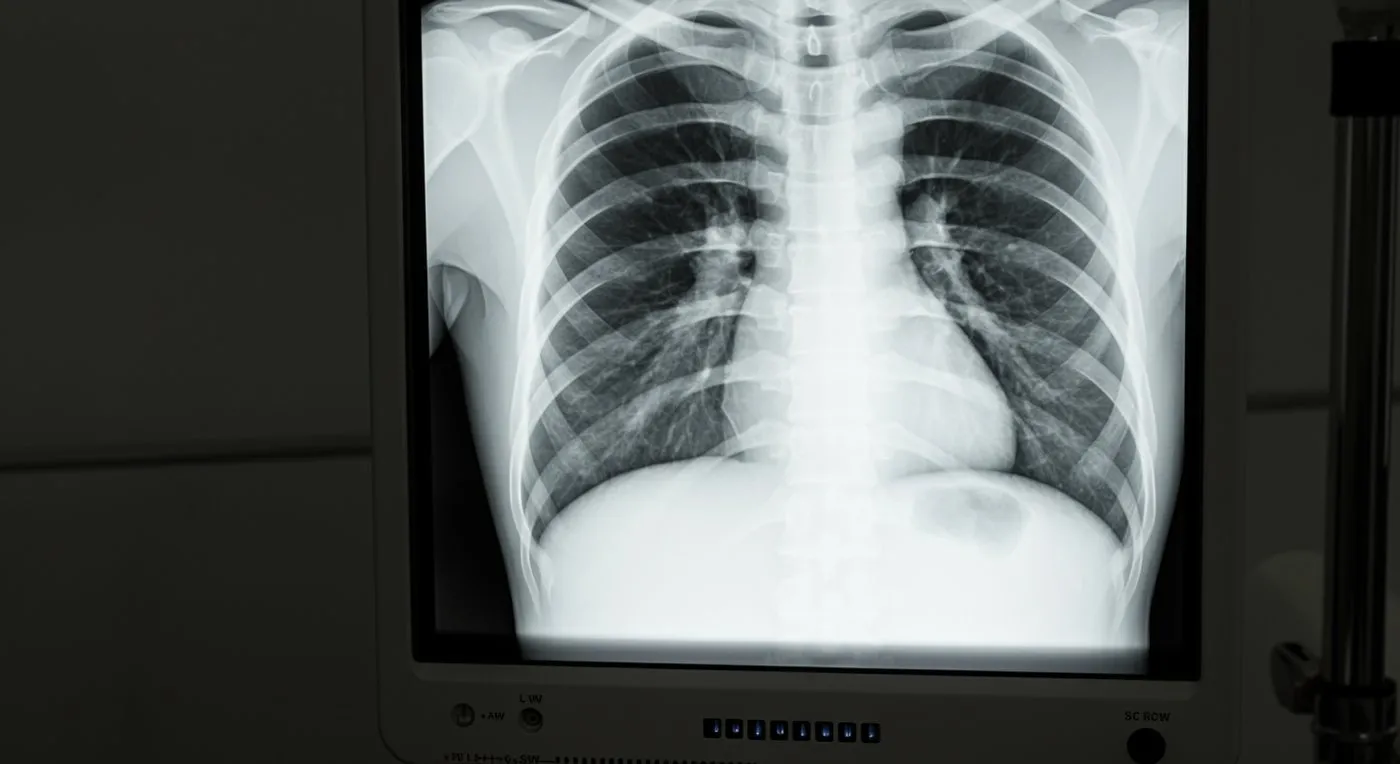
It starts the same way every oxygen problem starts. At high pressure, oxygen throws off reactive molecules faster than the lung's cleanup systems can handle them (the chemistry is its own article: oxygen toxicity and ROS). In the lungs that damage turns into inflammation: the cells that make your lungs' natural lubricant get hit, the tiny blood vessels start to leak, and gas exchange slowly stiffens up. You feel it as a dry, nagging cough, a burning or tight feeling behind the breastbone that's worse on a deep breath, and breathlessness when you work. Measured on a spirometer, it shows up as a drop in how much air you can move.
Measuring the dose: OTUs
Because the damage adds up, you track it as a running total, the OTU (oxygen toxicity unit; older texts call the same thing a UPTD). One OTU is roughly the dose from one minute at a PO₂ (oxygen pressure) of 1.0 bar. Below 0.5 bar the clock simply doesn't tick, and that's an accounting floor, not the point where damage suddenly starts.
The dose for any stretch of a dive comes from a formula your computer runs for you once it knows your mix. You never work it out yourself, so don't memorise it:
OTU = time (min) × ( (PO₂ − 0.5) / 0.5 )^0.83 (only when PO₂ > 0.5 bar)
How much should you trust that number?
Less than the tidy formula suggests. The OTU model dates from 1970 and was fitted to a handful of high-oxygen-pressure exposures, scored as a drop in how much air you can forcibly blow out (your vital capacity). Three things make it shaky for the diving most of us do:
- It was calibrated up at 1.0 to 3.0 bar (hyperbaric-medicine territory), not the 0.85 to 1.4 bar band rebreather and nitrox diving actually use, so it's probably over-cautious there.
- It has no real way to model recovery between dives. It just keeps adding.
- The "2% drop in vital capacity" it calls a day's dose is smaller than the few percent (around 3 to 5%) your lung capacity wanders on its own from day to day, so the thing it measures is barely above background noise.
The researchers who study this have largely moved on. Ran Arieli's "power equation" scales risk with time squared and, crucially, includes recovery between dives; Barbara Shykoff's model predicts the actual probability of symptoms after 1.3-bar dives. Shearwater publishes a note bluntly titled "Why UPTD Calculations Should Not Be Used," and the commercial-diving medical body (DMAC) has switched to the newer index. None of that has reached the firmware in your dive computer yet, so OTUs remain the flawed but default tool, exactly like the old CNS table was until it was revised in 2025.
Staying clear of it
- Let your computer track OTUs, but treat the number as a rough running tally, not gospel. Watch the trend across the week, not the last digit.
- Aim to stay under roughly 850 OTU in a day, and ease that ceiling down as days stack up.
- On long rebreather dives, drop the setpoint, the oxygen pressure it holds you at, toward 0.7 to 1.2 bar. The decompression you save by holding 1.3 over 1.2 is tiny; the pulmonary cost over several hours is not.
- A cough or chest tightness that lingers after diving is a clinical sign. Rest and reassess, and remember a full day off lets the dose largely recover.
- Planning an expedition or a liveaboard week? That's where the dose really adds up: see oxygen over a multi-day trip.
Keep reading
- Oxygen on a Multi-Day Trip: where pulmonary load actually bites
- Oxygen Toxicity & ROS: the chemistry behind all of it
- CNS Oxygen Toxicity: the fast, dangerous version
- Gas Density & CO₂ Buildup: why long, deep dives load you up
References
- Clark JM, Lambertsen CJ. Pulmonary oxygen toxicity: a review. Pharmacol Rev. 1971;23(2):37–133. doi:10.1016/s0031-6997(25)06887-5
- Bardin H, Lambertsen CJ. A Quantitative Method for Calculating Pulmonary Toxicity: Use of the Unit Pulmonary Toxicity Dose (UPTD). Univ. of Pennsylvania, 1970.
- Hamilton RW. REPEX: Development of Repetitive Exposure Tables for Oxygen. National Undersea Research Program, 1989.
- Shykoff BE. Pulmonary oxygen toxicity. Undersea and Hyperbaric Medicine. 2019;46(5):599–609.
- Arieli R. Uncertainty in the estimates of the risk of pulmonary oxygen toxicity in humans. European Journal of Applied Physiology. 2011;111(10):2405–2411.
- NOAA. NOAA Diving Manual.
I plan gas mixes around pulmonary limits on every long CCR and trimix dive I teach. Ask me about training.
Common questions
What is pulmonary oxygen toxicity?
It is a slow inflammation of the lungs from breathing raised oxygen for a long time, like a sunburn on the inside of your lungs. It builds over hours and across days, shows up as a dry cough and chest tightness, and heals once you stop.
What is an OTU?
An oxygen toxicity unit (OTU, also called UPTD) tracks the cumulative pulmonary oxygen dose. One OTU is roughly the dose of one minute at a 1.0 bar oxygen partial pressure; below 0.5 bar the clock does not tick.
Is pulmonary oxygen toxicity dangerous for recreational divers?
Rarely. On almost any single recreational or technical dive your gas, decompression, and CNS limits run out long before pulmonary toxicity, and the lung effects are mild and reversible. It mainly matters on multi-day and rebreather diving.
Share this post