Sidewinder CCR MOD1
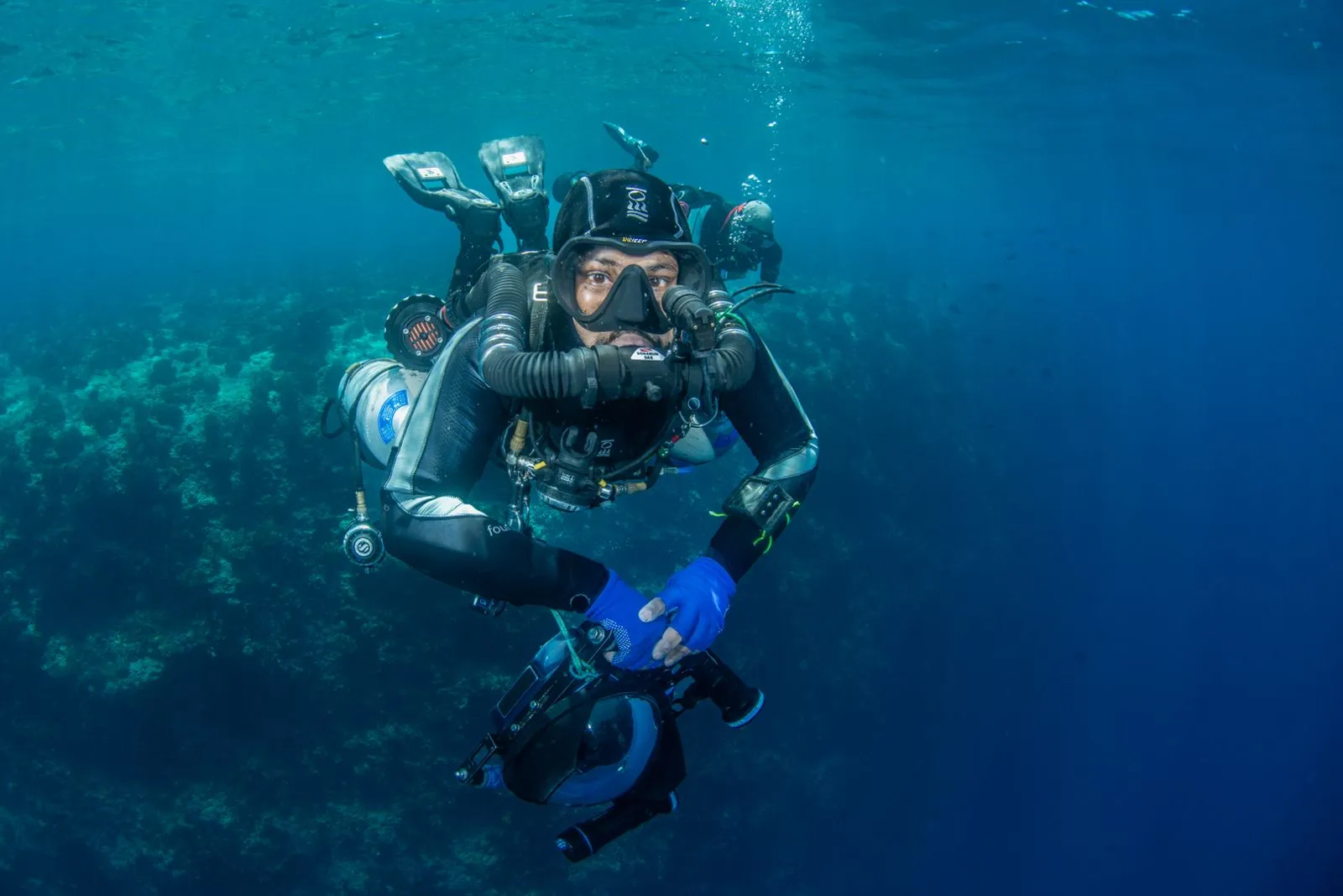
Rebreathers kill more divers than open circuit. That's worth understanding.
A 2012 analysis of diving fatalities found that the risk of dying on a rebreather was ten times higher than on open-circuit scuba. Not marginally higher. Ten times.
That number isn't an argument against rebreathers. It's an argument for understanding exactly why the risk exists, and for training that directly addresses it.
Most CCR fatalities share a small set of causes: oxygen toxicity, hypoxia, and drowning after losing consciousness. Most of those begin with a failure of monitoring discipline or a failure of bailout execution. Not equipment failure. Not bad luck. Trained responses that weren't trained to the right standard.
The MOD1 course is built around this reality. Not the marketing version of CCR training, but the version that takes the failure modes seriously and practices the responses until they're automatic, not just understood.
Training that's worth travelling for
Most divers learn CCR wherever they can reach: a cold quarry, a lake, a weekend at a time, water you can barely see your gauges in. It works, but it's the hardest possible place to build the two things MOD1 actually turns on: buoyancy under the loop, and calm problem-solving under task loading. Both come faster when you can see, when you're warm, and when you can dive the same skills twice a day for a week instead of once a fortnight.
That's the case for coming here. Training runs in warm, clear water in the Maldives and Sri Lanka, in one continuous block built around your travel rather than a fixed calendar. Groups are small, 1:1 or 1:2, so the whole week is your water time. You fly in, you dive every day, and you leave with the foundation built properly.
If you're travelling from the US or Europe, tell me your dates and what you're diving now and I'll build the block around them.
What the Sidewinder actually is
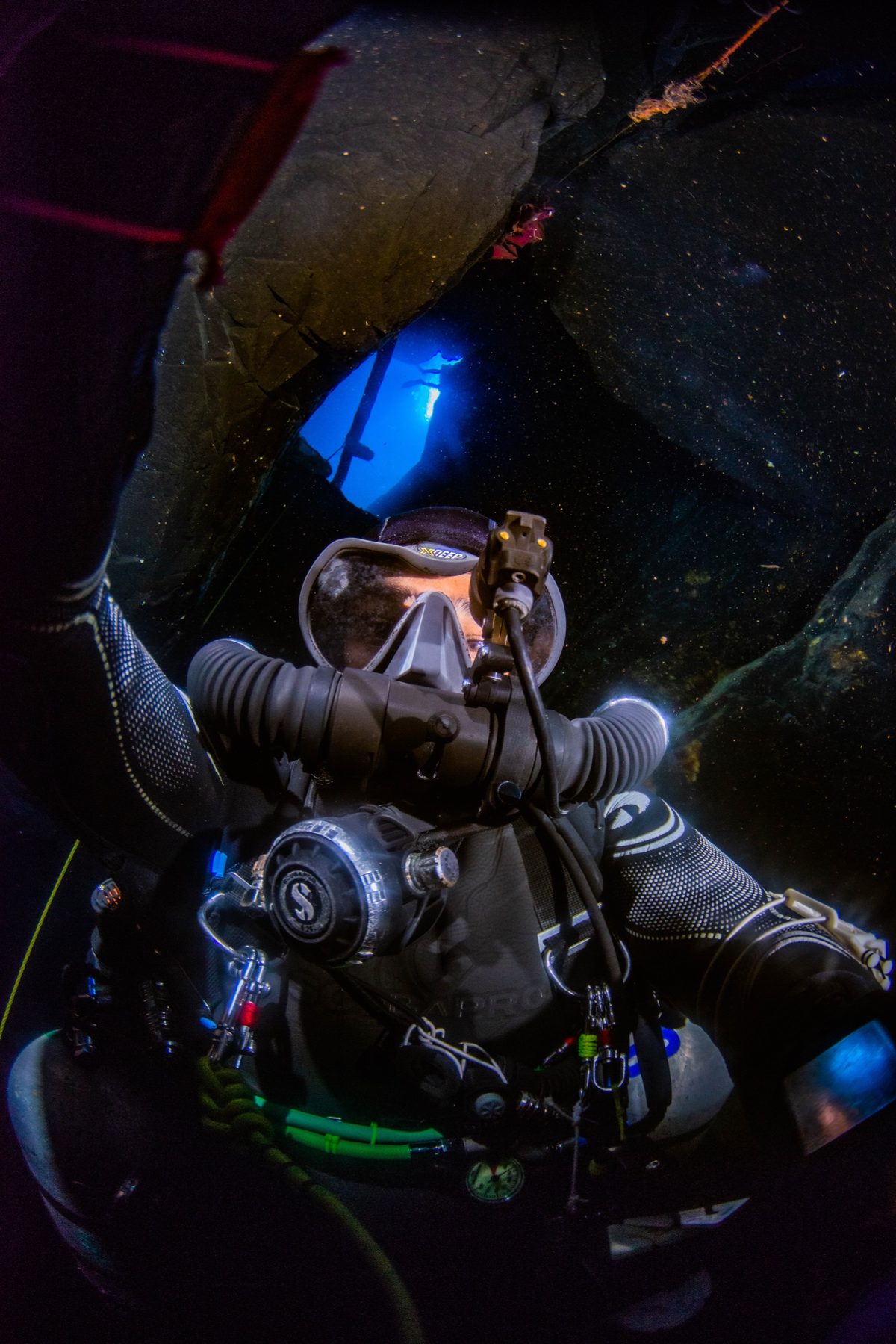
The KISS Sidewinder is a passive-addition, sidemount-mounted, manual closed-circuit rebreather. There are no active electronics controlling oxygen injection. The diver controls setpoint by managing the dive profile and manually adding oxygen. This makes it mechanically simpler than electronically-controlled units, and operationally more demanding of the diver.
It's the right tool for cave diving, expedition work, and environments where simplicity and robustness matter more than automation. It's used in Bhimkund's sump systems, in the Maldives on long-range DPV runs, and on deep walls where bottom time on open circuit would require gas volumes that are logistically impractical.
I dive mine in these environments. MOD1 training reflects that use, not a manual-based course delivered in a pool.
If you're still weighing whether CCR is your next step, how a rebreather works, and what makes it unforgiving is the plain-English starting point. The classroom theory for the course itself is delivered as structured online modules before you arrive, so your days here are spent in the water, not sitting through lectures.
How the loop works · KISS Sidewinder mCCR
Gas leaves your mouthpiece (DSV), runs down the exhale counterlung and through the CO₂ scrubber, then up the inhale counterlung past the three oxygen cells and back to you. Oxygen is injected as your body uses it; diluent is added on descent. Adapted from our KISS Sidewinder MOD1 course.
What you'll learn
Why rebreathers are more dangerous, and how to close the gap
Before any in-water training:
- The physiology of hypoxia and hyperoxia: how they kill, how they present, why the presentation often gives no warning
- Why PO₂ management on a passive-addition unit is more demanding than on electronic CCRs
- The actual failure modes in CCR fatality data: what failed, at what point in the dive, what response was missing
- The discipline habits that change the risk profile: pre-dive checks, loop monitoring frequency, bailout readiness
This isn't a lecture to get through before the diving starts. It's the framework that everything else sits on.
System engineering: understanding the machine completely
The Sidewinder is simple. Simple doesn't mean forgiving of misunderstanding.
- Loop gas flow mechanics and how counterlung position affects work of breathing
- Scrubber chemistry: CO₂ absorption rate, duration limits, caustic cocktail failure mode, and the conditions that accelerate scrubber saturation
- Oxygen addition: ADV function, MAV role, manual injection discipline, and what happens when addition fails in either direction
- PPO₂ dynamics across depth changes: how passive addition interacts with descent and ascent
- Water ingress pathways and loop flood response
- O-ring maintenance, scrubber packing standard, and what an incorrectly packed scrubber looks like on a dive
Setup, configuration, and daily pre-dive protocol
- Mounting and hose routing for your body, harness, and intended environment
- Oxygen and diluent cylinder placement: accessible under gloves, under stress, in restricted spaces
- Bailout valve integration and BOV position logic
- Pre-dive checklist to a standard that catches real problems, not just ticks a box
- Positive and negative pressure tests: what they confirm and what they miss
- Expedition packing: protecting the unit in transit, pre-dive assembly in non-ideal conditions
Buoyancy, trim, and loop discipline
More time is spent here than anywhere else in the course. This is where new CCR divers most commonly fall short.
- Loop volume as a buoyancy variable: understanding the interaction completely before trying to manage it
- Breathing pattern discipline: slow, deliberate cycles that maintain stable PO₂ and stable buoyancy simultaneously
- Back-kick and helicopter turn under the unit's weight, with both counterlungs loaded
- Horizontal trim with Sidewinder mounted: the unit changes your balance point in ways that have to be explicitly compensated
- Loop flush efficiency: getting full scrubber benefit without unnecessary gas consumption
- Stillness at depth: the CCR skill that most open-circuit divers underestimate
Skills are filmed daily. Review is part of the training, not optional.
Emergency procedures: trained to automatic
Every procedure gets drilled until the response is immediate, regardless of what else is happening on the dive.
- Hypoxia response, including the scenario where the first sign is a team member noticing, not self-awareness
- Hyperoxia and CNS oxygen toxicity: recognition at depth, immediate bailout execution
- Loop flood: partial and full, managed ascent on loop versus bailout decision point
- BOV failure and DSV failure, the two scenarios most CCR divers know least about
- ADV runaway and oxygen addition failures in both directions
- Oxygen and diluent shutdown procedures at depth
- Full bailout ascent, with decompression obligation, with a disoriented team member, in current. Practiced repeatedly, not described once.
- PO₂ management without sensor feedback
- CO₂ breakthrough recognition: the headache, the breathing pattern change, the urgency of the response
No scenario is considered trained until it's handled correctly under task loading.
Dive planning for CCR
- CNS and OTU tracking across multi-dive CCR days: the numbers are different from open circuit and the margin matters
- Scrubber duration calculation for your planned profile, with conservative factors applied
- Bailout gas requirements: the actual calculation, not the rule of thumb that leaves divers short
- Decompression gradient factor strategy for CCR profiles
- Gas matching when diving with open-circuit team members
- Dive log discipline: the data that matters for pattern recognition over a CCR diving career
My Sidewinder background
The training reflects how I actually use the unit:
- Bhimkund cave system: sump dives in one of Asia's most significant flooded cave networks
- Meghalaya: sidemount cave diving in high-flow northern Indian cave systems
- Maldives Across Project: long-range DPV/CCR expedition work across open ocean
- Deep wall diving at Lakshadweep: extended bottom time profiles in blue water
MOD1 with me is the foundation that determines the next thousand hours of your CCR diving. That foundation is built properly or it isn't built at all.
How this is different from a typical MOD1
Most rebreather courses move you through a syllabus in a fixed number of days. This one is built around the way the unit actually gets used, and the small set of failures that account for most CCR deaths.
- Taught from real expedition use, not a manual. I dive the Sidewinder in caves, on deep walls, and on open-ocean DPV runs. The drills, the checklist standard, the gas planning: all of it comes from that, not from a slideshow.
- You progress on competence, not the calendar. 1:1 or 1:2 only. No shortened programmes, and extra days are built in and used often. You don't go deeper until the shallow-water skills are solid under stress.
- Failure-mode first. The course is organised around the causes in the CCR fatality data: hypoxia, hyperoxia, CO₂. Every response is drilled until it's automatic.
- Theory before you arrive. The classroom material is delivered as online modules in advance, so your time here is spent diving.
- Filmed and reviewed daily. You watch your own trim, loop discipline, and drills, and we fix them on camera.
Prerequisites
- Advanced Nitrox and Decompression Procedures strongly recommended: solid decompression execution competence is expected before starting CCR
- 100+ logged dives
- Stable buoyancy and trim on open circuit under task loading
- Calm situational awareness under stress: this is a psychological standard, not just a skill standard
If your open-circuit technical foundation needs work before CCR, that can be scheduled. Starting CCR with buoyancy gaps or decompression execution gaps is the profile that produces the accidents in the fatality data.
Course duration
6 to 7 full days. No shortened programmes. You progress when skills are stable, not when the schedule says you should.
- Maximum 1:1 or 1:2 instructor-to-student ratio
- Additional days available when needed, and regularly used
- No dive to deeper water until shallow-water performance is genuinely solid under stress
Gear
Bring your Sidewinder if you own one. Loan units can sometimes be arranged with significant advance notice. Mention your situation when you enquire.
Additional requirements:
- Sidemount harness compatible with Sidewinder mounting
- Oxygen and diluent cylinders appropriate to planned dives
- Bailout cylinders, sidemount preferred, with adequate volume for your planned profiles
- Two cutting tools
- Primary light and two backup lights
- Primary mask and backup mask
- Wrist slate
- DSMB and reel
- Dive computer with decompression capability and backup
All configuration is set up correctly for your body, harness, and intended environment before the first in-water session.
Where you'll train
The programme runs across warm-water sites in the Maldives, Sri Lanka, and southern India. Which one depends on your goals, your travel, and the conditions at the time. Confirmed when we schedule.
Maldives: blue-water buoyancy and long-bottom-time discipline in clean, predictable water. The best choice if expedition or long-range use is where you're headed.
Sri Lanka: varied reef and wreck diving with good visibility and easy logistics. A straightforward place to fly into for a focused week.
Southern India (Pondicherry, Lakshadweep): warm water with high dive repetition and varied conditions for a high-volume training block.
Meghalaya / Bhimkund: for divers with a clear cave CCR pathway. Skills built here are relevant from the first day.
How a training trip works
Most divers flying in book one continuous block: 6 to 7 diving days, plus a day either side for travel and gear prep. You dive every day; this isn't a course spread across weekends. Scheduling is built around your travel: tell me your window and I'll confirm the site and dates.
What comes next
MOD1 is the foundation for:
- MOD2: CCR Trimix, extending depth and gas complexity on the rebreather
- Cave CCR: Bhimkund, Meghalaya, and international cave projects
- Trimix 60 to 75m and Advanced Trimix: the Sidewinder removes the open-circuit gas volume constraint at those depths
- Long-range DPV expedition work: the Maldives Across Project and similar
- Bharat 100m project: CCR changes the gas logistics at 100m fundamentally
The theory behind the course
The depth notes cover the science the course puts into practice. Worth reading before you arrive:
- Rebreather diving: how a CCR works, and is it dangerous?
- CNS oxygen toxicity
- Gas density and CO₂ buildup
- Gradient factors
- Safe ascents
Frequently asked questions
Can I do a CCR or rebreather course in India?
Yes. Closed-circuit rebreather (CCR) MOD1 training on the KISS Sidewinder runs in India — Pondicherry, Lakshadweep, and the Meghalaya cave systems — as well as in Sri Lanka and the Maldives. It's taught by Donarun Das, a TDI-certified rebreather instructor who dives the unit on cave, deep-wall, and open-ocean expeditions across the region. Rebreather training is the course most divers assume they have to leave the region for. You don't.
Are rebreathers actually safe?
On open circuit, the fatality rate for technical divers is around 1 in 200,000 dives. On CCR, the comparable figure has historically been around 1 in 20,000, ten times higher. That gap has narrowed as training standards have improved and equipment has become more reliable. It narrows further for divers who train to a genuine standard and maintain their discipline after certification.
The honest answer: rebreathers are more dangerous than open circuit and will remain so, because the failure modes are less forgiving. The training response is rigorous pre-dive protocol, frequent monitoring, and bailout execution practiced until it's automatic, not a set of habits you maintain until they slip.
Do I need to own a Sidewinder before the course?
Ideally yes, plan to own the unit you'll dive after certification. A loan unit can sometimes be arranged with significant advance notice. Diving a borrowed unit for a course and then having no unit after it creates a practice gap at exactly the wrong time in skill development.
What's the difference between MOD1 and MOD2?
MOD1 covers open-water CCR diving to recreational and light technical depths. MOD2 adds trimix gas mixes, extended decompression profiles, and deeper mixed-gas CCR diving. MOD2 and cave CCR both require MOD1 as the prerequisite: the foundational skills from this course are load-bearing for everything above it.
Why the Sidewinder specifically?
It's a passive-addition unit: the diver controls oxygen management, not electronics. This makes it mechanically robust and highly appropriate for cave, expedition, and long-range work where electronic complexity is a liability. It's also the unit I dive in the environments the course is preparing you for.
What's the most common reason people leave MOD1 without a certification?
Buoyancy and loop discipline. Not conceptual understanding, but physical execution. The combination of loop volume management and buoyancy control, under task loading, is a genuinely new skill set that takes full course time to develop. Divers who arrive with strong buoyancy on open circuit still spend most of the first two days recalibrating. This is normal. The course duration is set accordingly.
Enquire about MOD1 training
Tell me where you're diving now, what you're working towards, and your rough travel window. I'll tell you honestly whether MOD1 is your right next step, and build a block around your dates.
Enquire here. I answer every enquiry myself, whatever your timezone.
Pricing
Pricing is tailored to your course, location, and schedule. A full breakdown is provided before any commitment is made.
Frequently asked questions
- What are the prerequisites for Sidewinder CCR MOD1?
- No specific prerequisites; enquire directly to confirm the course suits your experience level.
- What certification do I receive after completing Sidewinder CCR MOD1?
- You receive a TDI Sidewinder CCR MOD1 certification, recognised worldwide, upon successful completion.
- How long is the Sidewinder CCR MOD1 course?
- The Sidewinder CCR MOD1 course runs for 6 to 7 days.
- Where do you run this course?
- Courses run across the Maldives, Sri Lanka, and India (Pondicherry, Lakshadweep, and Meghalaya), scheduled around your dates and the right dive site for the course.
- How much does Sidewinder CCR MOD1 cost?
- Pricing is quoted individually, because dive centre fees, certification costs, and logistics vary by course, location, and schedule. You get a full breakdown before any commitment.
- Who teaches this course?
- Donarun Das, a TDI Trimix Instructor, KISS Sidewinder CCR Instructor, and PADI Staff Instructor teaching across the Maldives, Sri Lanka, and India, with 15+ years of diving experience and a mechanical engineering background from NIT Silchar.