Trimix 60 to 75m
The narcosis reversal
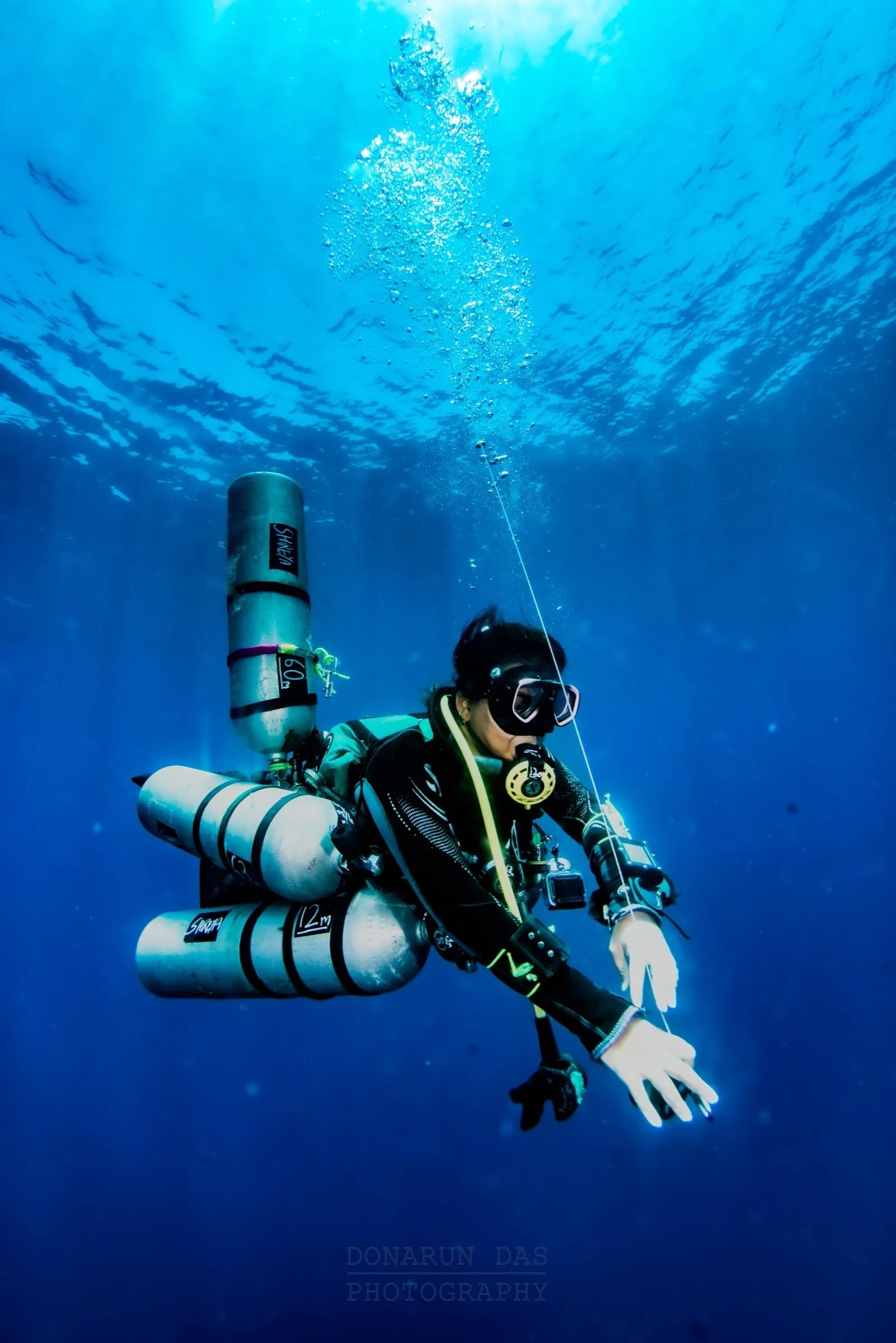
Divers who train at 50m on air and then switch to trimix for the first time at 60m describe a consistent experience: arriving at depth and finding, unexpectedly, that they can think clearly. The mental fog that was manageable at 50m is gone. Decisions that took deliberate effort at depth feel straightforward. The workload they were managing carefully becomes easier.
This isn't a small difference. It's a fundamental change in the dive, and it's why helium isn't really about going deeper. It's about diving with the cognitive resources the depth actually demands.
The 60 to 75m range is where this matters operationally. The deep walls across the Indian Ocean, the significant wrecks of Southeast Asia, the blue-water dive sites of the Maldives: the diving worth doing in this depth range requires a diver who is genuinely functional at depth. Trimix provides that. Air at these depths doesn't.
What this depth range opens up
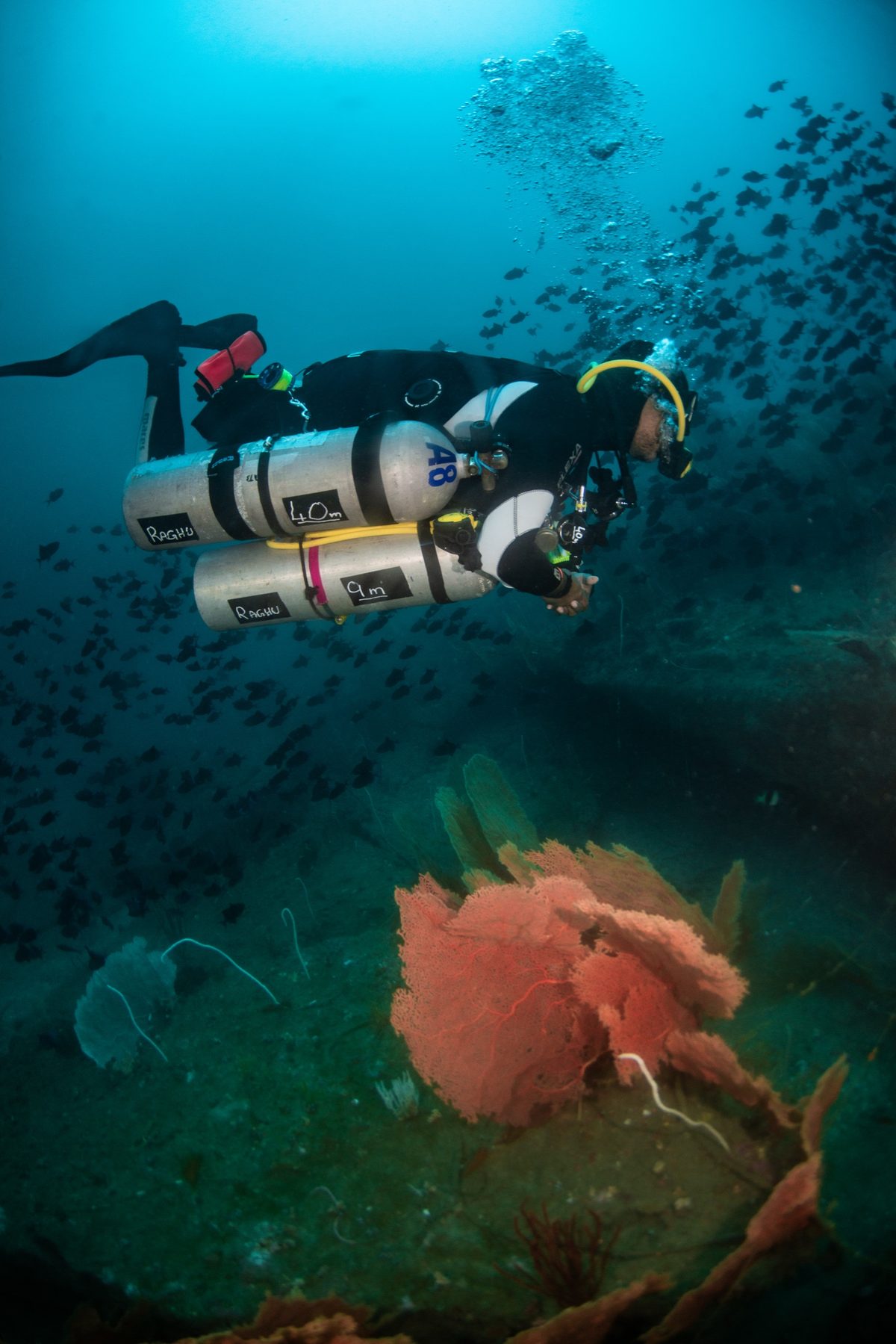
The deep wall dives that matter across the region, where visibility stretches further than anywhere else and the big pelagics patrol below 60m, sit in exactly this range. The same depth band holds the accessible section of most historically significant wrecks and the productive zone on most Indian Ocean reefs.
This is the training for the diving that's actually worth doing out here.
What you'll learn
Trimix gas planning: the full logic
Not the simplified version. The actual reasoning behind every number.
- Normoxic trimix for 60 to 65m: helium fraction selection based on END target, not convention
- Hypoxic trimix for 70 to 75m: oxygen below 18%, the handling implications, why it's necessary at this depth
- END calculation: choosing the helium fraction that gives you the narcosis level you can manage
- Gas density with helium: how it changes breathing mechanics, CO₂ clearance, and work of breathing
- PPO₂ management from hypoxic bottom gas through the full decompression sequence
- Rock-bottom gas calculation for multi-stage trimix: realistic numbers, not conservative estimates that leave you confused
- CNS oxygen budget across a full dive day on trimix profiles
Equivalent Narcotic Depth · build a mix, read the fog
Nitrogen 79% · the part that fogs you
Aim for an END of 30 m or less for anything that needs clear thinking. Drag helium in and watch both the fog and the density fall: that's why deep dives move to trimix.
Isobaric counterdiffusion
Mixing gases during ascent creates counterdiffusion risk when the switch is made incorrectly. You'll learn the actual mechanism, the conditions that make it a genuine hazard, and the protocols that prevent it. Not the simplified rule, the physiology.
Decompression strategy for helium-containing mixes
Helium off-gasses differently from nitrogen. This changes how decompression is planned and executed:
- Fast-tissue helium off-gassing vs. slow-tissue nitrogen behaviour across a long profile
- Gradient factor adjustments for high-helium bottom mixes
- Deep stop evidence in the trimix context: what the data actually shows
- Ascent curve shaping for cold, high workload, and high-helium conditions
- Managing slow-tissue loading across multiple decompression gases
Multi-stage logistics
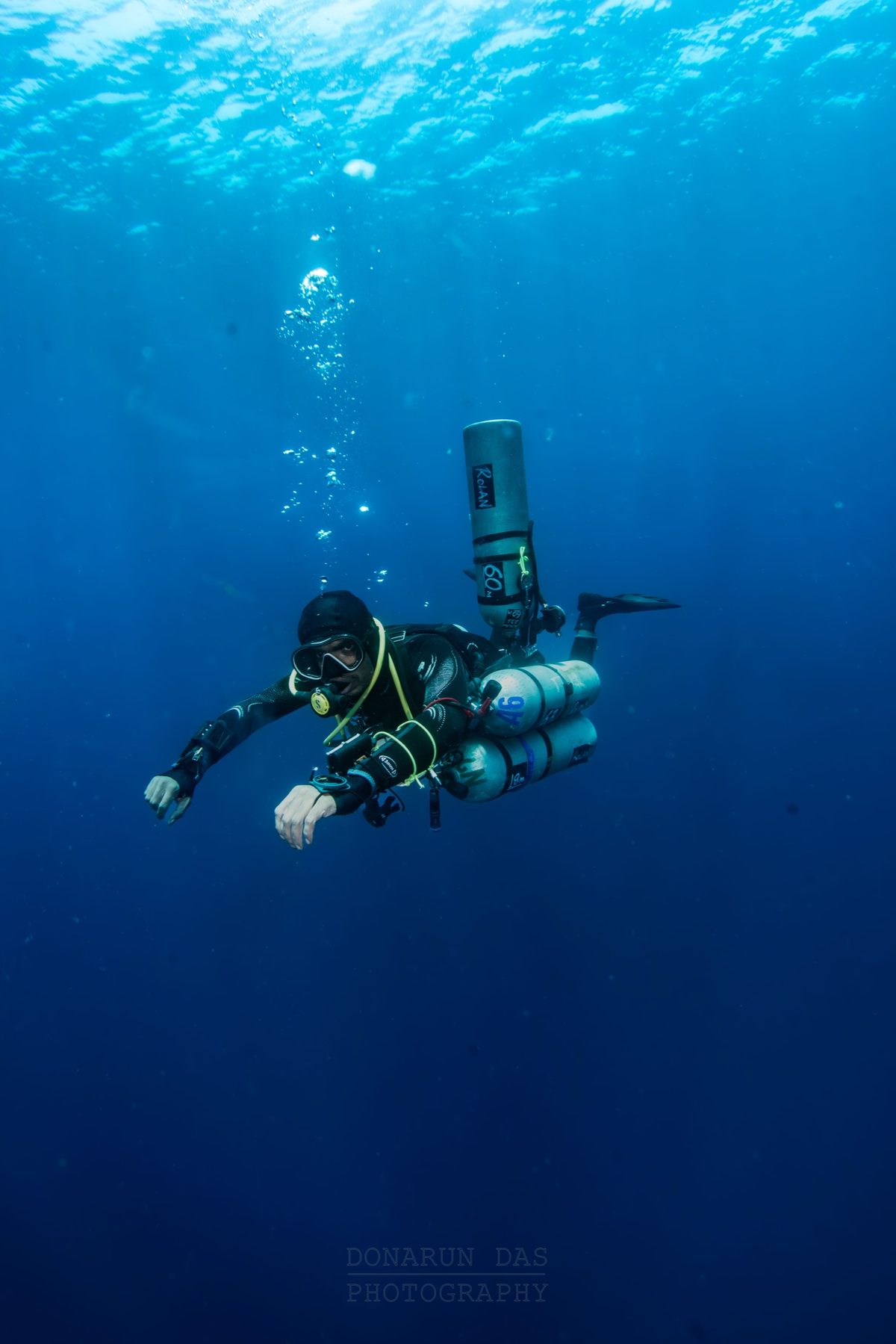
- Gas stacking: bottom mix, EAN50, 100% oxygen, with planning, labelling, rigging, and pre-dive checks
- Gas switch discipline at 21m and 6m in current and low visibility
- Managing three cylinders simultaneously without confusion under stress
- Planning for the loss of any single gas at any point in the dive
Failure scenarios, trained until automatic
- Lost deco gas before the planned switch point
- Hypoxic mix confusion on the bottom
- Narcosis breakthrough despite helium when workload increases unexpectedly
- Regulator freeflow at 70m
- Team separation with asymmetric decompression obligations
- Long-hose deployment in current at depth
- CO₂ buildup recognition and managed ascent response
All dives are filmed and reviewed before progression to greater depth. If a scenario isn't handled cleanly in practice, we don't progress.
Helium logistics, handled
Helium is the constraint most Asia-based technical divers eventually hit. Supply is concentrated, lead times are real, and incorrect mix delivery isn't theoretical.
I've worked with verified gas suppliers across the training locations for years. Gas logistics (sourcing, mix verification, cylinder coordination) are handled as part of course organisation. You won't arrive to find helium unavailable, delayed, or incorrectly blended.
Prerequisites
- Tec 50 / TDI Extended Range, or equivalent open-circuit technical certification with documented decompression dives
- 100+ logged dives
- Solid buoyancy and trim under full stage load
- Demonstrated gas switching and decompression execution competence
If you're unsure whether your Tec 50 skills are at the required standard, an honest assessment is part of the pre-training process. No one benefits from starting trimix with gaps in the preceding foundation.
Course duration
4 to 5 days, mastery-based. Training starts at 60m and extends to 75m only when 60m performance is genuinely solid under task loading.
Gear
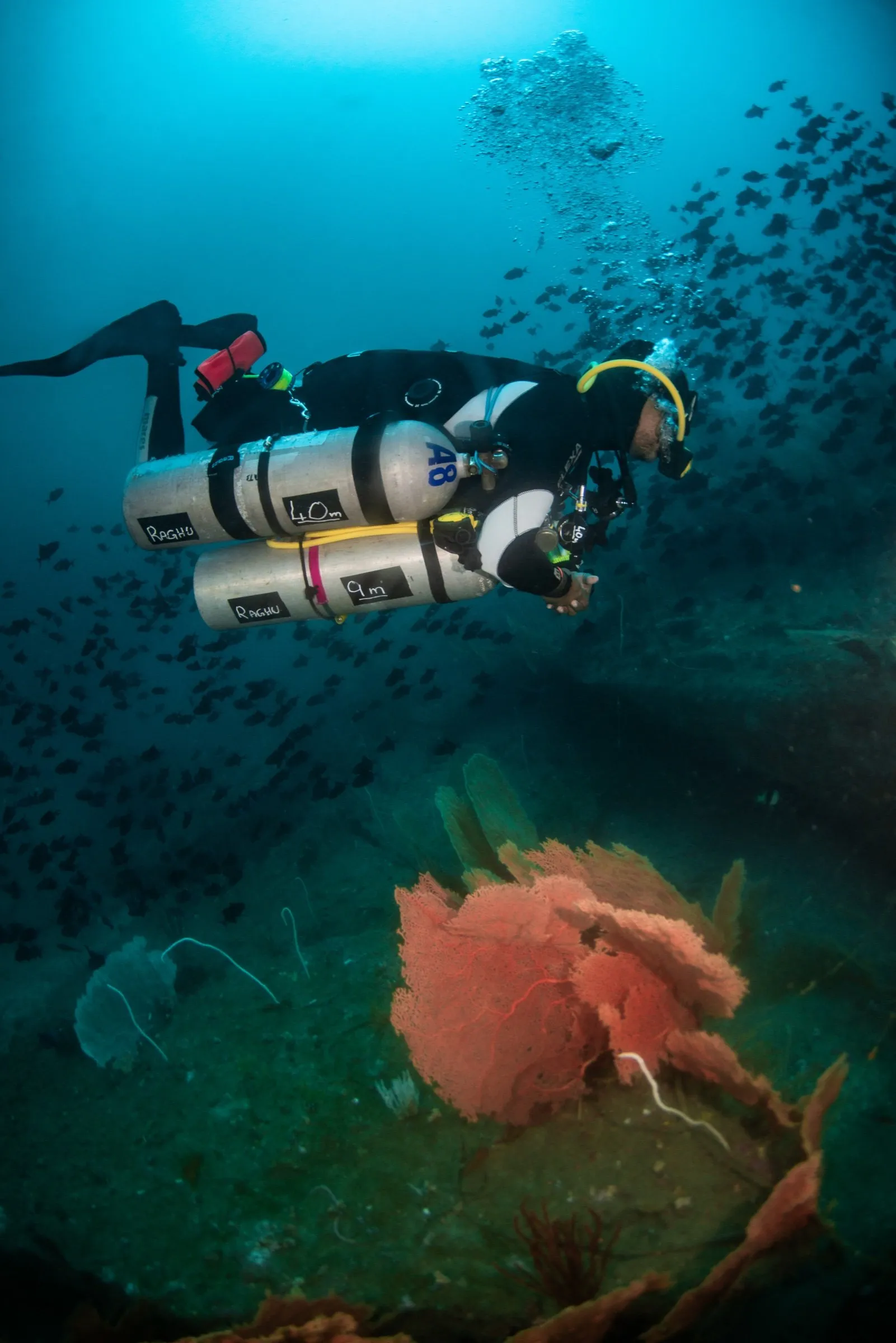
- Twinset or sidemount balanced for trimix
- Two to three stage cylinders (EAN50 + O₂ mandatory; trimix bottom mix as required)
- Long-hose primary configuration
- Two cutting tools
- Primary and two backup lights
- Wrist slates and wetnotes
- Two DSMBs with reels
- Two computers with trimix/decompression capability
Training locations
Training runs across the Maldives, Sri Lanka, and India. The deeper stages (70m and above) work best in locations with blue water and reliable deep wall access. Location is confirmed when scheduling based on your goals and the season.
What comes next
- Advanced Trimix / Road to 100m: hypoxic planning at full depth
- Sidewinder CCR MOD1: remove the gas volume constraint at depth
- Cavern: if overhead environment training is the parallel goal
The theory behind the course
The depth notes go deeper on the science this course puts into practice:
Frequently asked questions
What's the difference between normoxic and hypoxic trimix?
Normoxic trimix contains at least 18% oxygen, so it can be breathed at the surface safely. Hypoxic trimix has less than 18% oxygen and is only safe to breathe at depth. For 60 to 65m, normoxic mixes are standard. For 70m and below, the additional helium required to meaningfully reduce narcosis pushes the oxygen fraction below 18%, requiring hypoxic mix handling. This course covers both.
TDI Trimix or PADI Tec 65 Trimix?
Both cover normoxic trimix to the 60 to 75m range. TDI Trimix is the pathway toward TDI Advanced Trimix and the 100m progression. PADI Tec 65 leads into PADI Tec 100. Your long-term agency pathway determines which is appropriate, so discuss this when you enquire.
What does helium actually cost for this course?
Gas is billed at cost from verified local suppliers, no markup. Estimates are provided when scheduling.
Is there a difference between 60m and 75m trimix?
Yes. At 60 to 65m, normoxic trimix with modest helium fractions (10 to 20%) addresses narcosis meaningfully while keeping gas handling simple. At 70 to 75m, effective narcosis management requires higher helium fractions that push the bottom mix into hypoxic territory. Planning, handling, and failure responses differ. The course builds both levels sequentially.
Enquire about training
Enquire here. I answer every enquiry myself, whatever your timezone.
Pricing
Pricing is tailored to your course, location, and schedule. A full breakdown is provided before any commitment is made.
Frequently asked questions
- What are the prerequisites for Trimix 60 to 75m?
- No specific prerequisites; enquire directly to confirm the course suits your experience level.
- What certification do I receive after completing Trimix 60 to 75m?
- You receive a TDI / PADI Trimix 60 to 75m certification, recognised worldwide, upon successful completion.
- How long is the Trimix 60 to 75m course?
- The Trimix 60 to 75m course runs for 4 to 5 days.
- Where do you run this course?
- Courses run across the Maldives, Sri Lanka, and India (Pondicherry, Lakshadweep, and Meghalaya), scheduled around your dates and the right dive site for the course.
- How much does Trimix 60 to 75m cost?
- Pricing is quoted individually, because dive centre fees, certification costs, and logistics vary by course, location, and schedule. You get a full breakdown before any commitment.
- Who teaches this course?
- Donarun Das, a TDI Trimix Instructor, KISS Sidewinder CCR Instructor, and PADI Staff Instructor teaching across the Maldives, Sri Lanka, and India, with 15+ years of diving experience and a mechanical engineering background from NIT Silchar.