Browse Depth Notes
Post-Dive Fatigue
Why a day's diving wipes you out, and when the tiredness is a warning.
June 9, 2025 · 6 min read
Why you're wiped out after diving
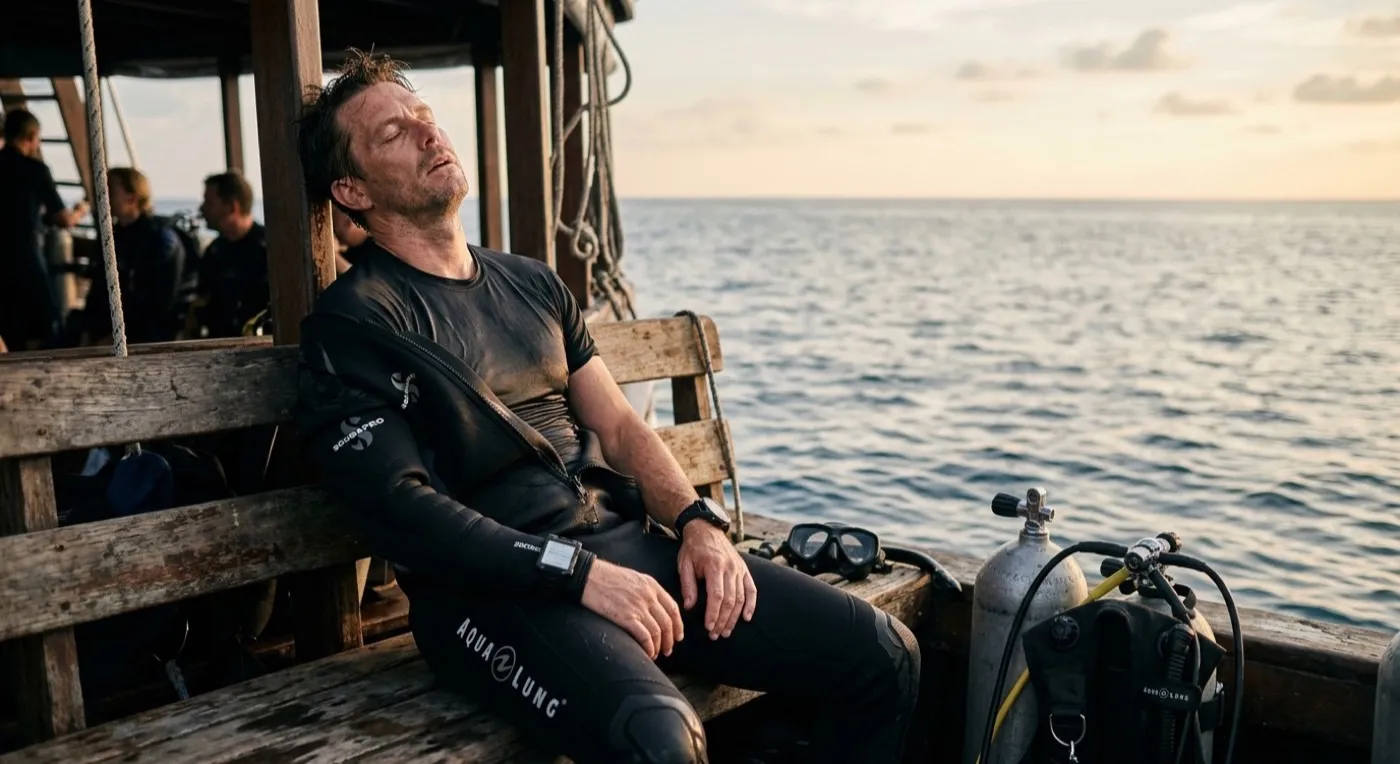
That bone-tired feeling after a day's diving is normal, and it comes from several things stacking up: the physical work of the dive, a quiet clean-up job your body does on the bubbles every dive produces, and ordinary contributors like cold, dehydration, and a bad night's sleep. Most of it is harmless. But because unusual tiredness can also be an early sign of decompression sickness (DCS, "the bends"), it is worth knowing which is which, covered below.
The physical work
Diving is more exercise than it looks. A study inferring effort from divers' gas use across a large set of real recreational dives (Buzzacott, Pollock and Rosenberg 2014) found recreational diving averages around 5 to 6 METs (a MET is a unit of effort: sitting quietly is 1, a brisk walk is about 5), with wide variation by fitness, cold, and task load.
For an 80 kg diver, a 45-minute dive at 5 METs is roughly 300 to 350 kcal; a demanding dive more; two dives in a day can run past 600 to 1,000 kcal once you add surface swims, hauling gear, and cold. That alone is a real part of why you are tired.
And the same work feels harder underwater. Dense gas at depth makes every breath more effort, and even mild CO₂ build-up brings fatigue, fog, and headache (which overlaps with early DCS, so keep it in mind). Cold burns extra energy. And the constant attention (buoyancy, navigation, gas, buddy) has its own metabolic cost: even an "easy" dive never lets your brain idle.
The bubbles your body cleans up
Every dive, even a shallow no-stop one, sheds small bubbles into the veins on ascent (venous gas emboli, VGE: the bubbles found with Doppler ultrasound, graded 0 to 4 on the Spencer scale). Most divers who feel fine register low grades, but "low" is not "none."
Fatigue tends to track those bubble grades: divers with higher signals after the same profile report more tiredness, more mental slowing, and more of that heavy, wrung-out feeling than divers with little or no bubble load. The reason seems to be the same low-grade inflammation described in the immune article: bubbles brushing the vessel lining trigger inflammatory messengers (IL-6 and TNF-alpha), the very cytokines that make you feel rough during an illness. Your body is producing them in response to bubbles, not a bug, but the feeling is much the same.
Cold makes both halves worse at once: it burns more energy and slows the off-gassing (gas leaving your tissues), which raises the bubble load that drives the inflammation.
The ordinary stuff that adds up
Before blaming physiology, account for the obvious: immersion makes you pee more (immersion diuresis), so you surface mildly dehydrated; early starts, boat travel, seasickness tablets, sun, and a poor night's sleep all pile on. These are often the biggest, and most fixable, part of post-dive tiredness.
What fitness changes
Aerobic fitness genuinely helps. Fitter divers breathe less gas for the same work (less CO₂, lower air consumption), tend to produce fewer bubbles and clear an inflammatory load faster, and recover quicker between dives. Good trim and an efficient kick help too: a streamlined diver uses noticeably less gas and effort than a sloppy one at the same speed, which means less work and less CO₂.
Recovering well
On the dive: ascend slowly with unhurried shallow stops, stay warm, breathe calmly, hydrate beforehand, and use nitrox sensibly if the profile warrants it.
Straight after: rehydrate with water or electrolytes (not alcohol), eat something with carbs and protein, and keep moving gently. Skip the hard gym session or hike: heavy exercise soon after a dive can actually push bubbles across into the arteries, especially in divers with a PFO (Madden et al. 2013), on top of loading a body that is already busy clearing.
Between dive days: this is where general aerobic fitness, leg and core strength for finning and trim, and mobility work pay off, and where rest and sleep do the real recovery (the window when inflammation settles and the immune system rebalances).
References
- Buzzacott P, Pollock NW, Rosenberg M. Exercise intensity inferred from air consumption during recreational scuba diving. Diving and Hyperbaric Medicine 2014;44(2):74–78. PubMed 24986724
- Pollock NW. Aerobic fitness and underwater diving. Diving and Hyperbaric Medicine 2007;37(3):118–124.
- Madden D, Lozo M, Dujic Z, Ljubkovic M. Exercise after SCUBA diving increases the incidence of arterial gas embolism. Journal of Applied Physiology 2013;115(5):716–722. doi:10.1152/japplphysiol.00029.2013
- Madden D, Ljubkovic M, Dujic Z. Intrapulmonary shunt and SCUBA diving: another risk factor? Echocardiography 2015;32(Suppl 3):S205–S210. doi:10.1111/echo.12815
- Obad A, Palada I, Valic Z, et al. The effects of acute oral antioxidants on diving-induced alterations in human cardiovascular function. Journal of Physiology 2007;578(3):859–870. doi:10.1113/jphysiol.2006.122218
Related reading
Train with me
Post-dive recovery and dive fitness are built into every multi-day technical programme I run. Enquire about training →
Common questions
Why am I so tired after scuba diving?
Several things stack up: the physical work of the dive, a low-grade inflammatory response to the bubbles your body clears, and ordinary factors like cold, dehydration from immersion, and a poor night's sleep. Most of it is normal.
When is post-dive fatigue a sign of decompression sickness?
Treat tiredness as possible DCS if it is unusual or comes with anything focal or progressive: tingling, numbness, weakness, joint pain, balance or visual changes, or symptoms lasting beyond 24 hours. When in doubt, get assessed.
How do you recover faster after diving?
Rehydrate, eat carbs and protein, sleep, and skip the alcohol and the hard gym session straight after a dive. Between dive days, general aerobic fitness and rest do the real recovery.
Share this post