Tec 50 / Extended Range
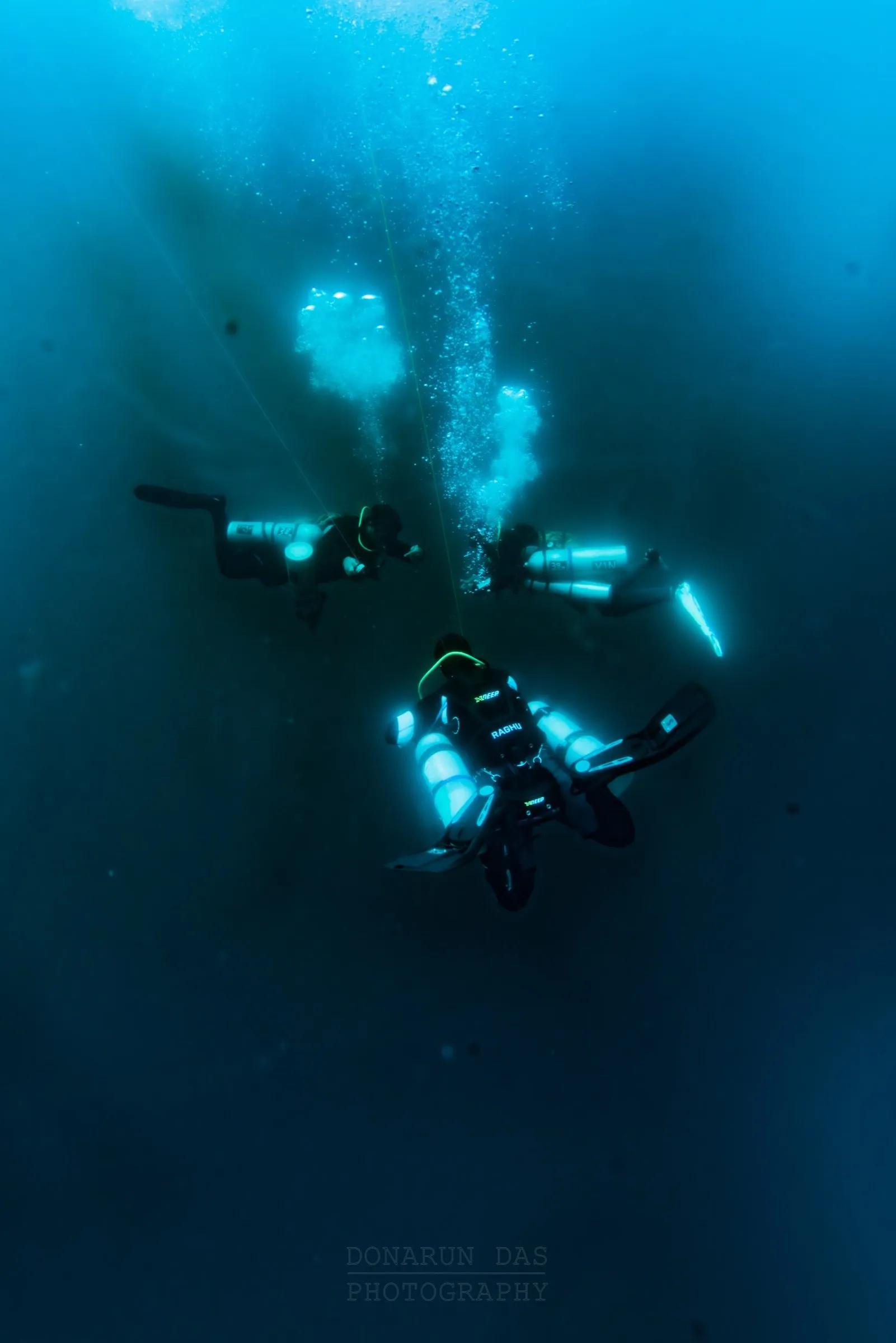
What 50 metres on air actually feels like
Nobody can accurately describe what nitrogen narcosis feels like to someone who hasn't been there. Mild versions at 30 to 35m feel like the slightly slowed thinking of mild wine. At 50m on air, it's something different: reaction times are measurably longer, problem-solving degrades, and the sense of certainty that experienced divers rely on becomes unreliable.
You don't stop functioning. You function more slowly and less precisely, in exactly the conditions where it matters most.
That's the honest reality of air-range diving at 50m. Tec 50 and TDI Extended Range train you to work at that depth deliberately: recognising your narcosis indicators early, adjusting your workload and planning accordingly, and making good decisions when the margin for error is smaller than it was at 40m.
It also makes the case for trimix more clearly than any lecture ever could. After training at 50m on air, the value of a clear head at depth isn't a theoretical argument. It's a felt experience.
Why this depth range matters
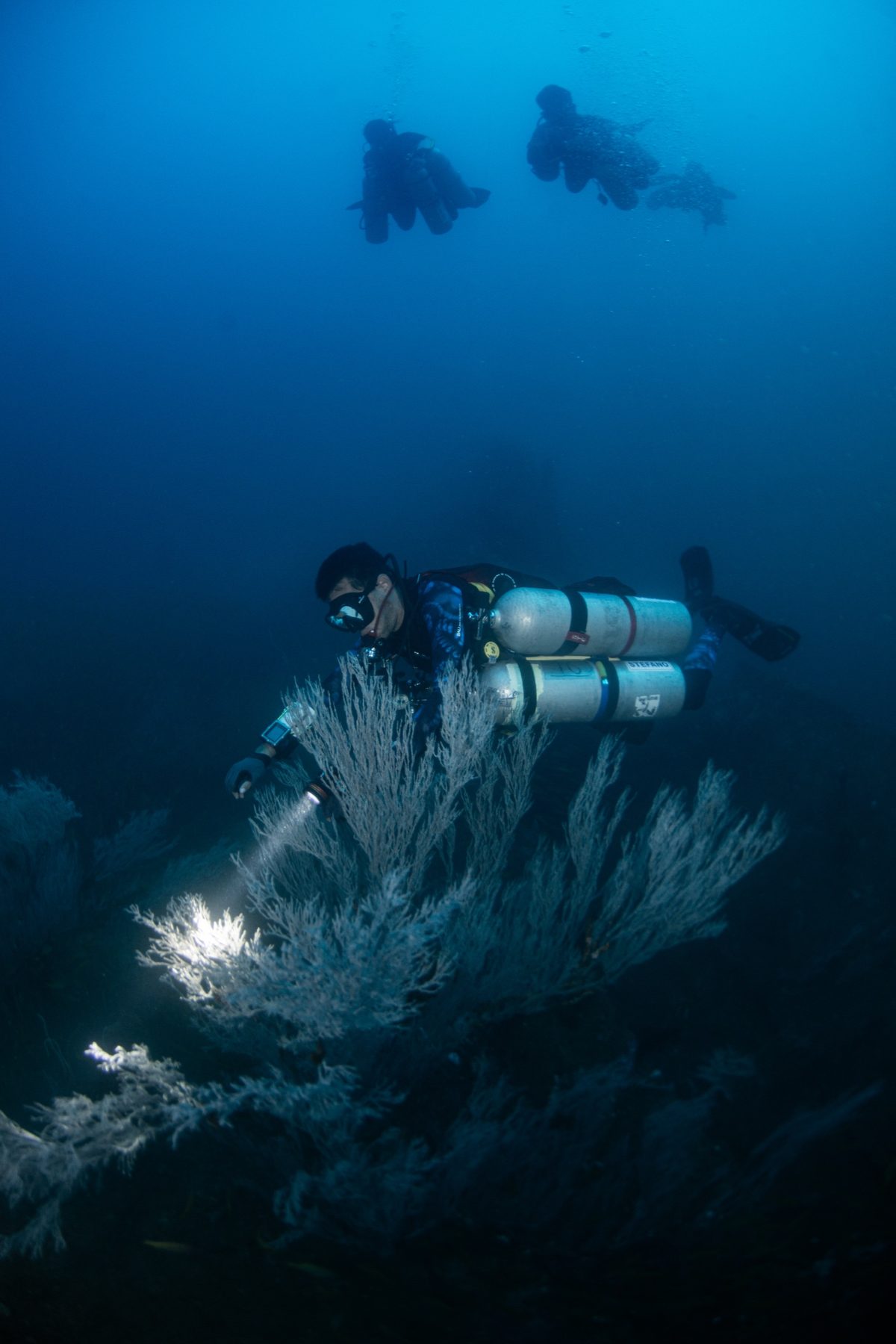
The Indo-Pacific's best diving sits in this range. The deep walls across the Indian Ocean, where coral density peaks and pelagic activity picks up, drop through 40 to 55m. For wreck divers, the most historically significant wrecks across South and Southeast Asia sit in this same band.
Training here opens that section to deliberate, planned, disciplined exploration rather than a rushed look before a conservative computer forces your ascent.
What you'll learn
Narcosis management at operational depth
At Tec 50 depths, narcosis isn't a risk to monitor in the background. It's a consistent presence to manage.
- Identifying your personal narcosis indicators before they affect performance
- Pre-dive planning that accounts for narcosis impact on task execution
- Stabilising at depth before beginning the planned work sequence
- Communication and decision protocols when a team member is showing narcosis signs
- The abort decision: when to cut the dive rather than push through
Equivalent Narcotic Depth · build a mix, read the fog
Nitrogen 79% · the part that fogs you
Aim for an END of 30 m or less for anything that needs clear thinking. Drag helium in and watch both the fog and the density fall: that's why deep dives move to trimix.
Three-gas dive planning
- Bottom gas, intermediate deco gas (EAN50), and shallow deco gas (100% O₂), planning all three
- Rock-bottom calculation at 50m with realistic elevated RMV under workload
- MOD management across three cylinders with different oxygen fractions
- Planning for the loss of any single gas at any point in the dive
- CNS oxygen budget management across the full gas sequence
Gas density and CO₂ at depth
Air at 50m is dense enough that breathing effort increases meaningfully. This affects CO₂ clearance: it's the physiological mechanism behind the "air hunger" some divers experience at depth.
- Understanding gas density and how it changes breathing mechanics
- Slow, controlled breathing at depth as a technical skill, not just a habit
- Recognising early CO₂ accumulation before it becomes a problem
- Adjusting workload and ascent rate when CO₂ is a concern
Task loading: the defining challenge of this course
Tec 50 training deliberately adds complexity to in-water scenarios:
- Equipment problems during descent with a decompression plan already committed
- Gas switch failure at a critical switch depth
- Computer discrepancy between team members during ascent
- Navigation problem at 50m with a decompression obligation building
- Buoyancy instability during decompression while managing three cylinders
Skills aren't evaluated in ideal conditions. They're evaluated when something else is also happening.
Decompression execution from 50m
- Ascent discipline from 50m with multiple stop depths and stop times
- Managing drift during extended decompression in current
- DSMB deployment in low visibility and surface traffic
- Stop precision when buoyancy is compromised by gas consumption changes
- Emergency decompression decisions when the run time extends beyond the plan
Prerequisites
- Tec 45 / Advanced Nitrox & Decompression Procedures, or TDI equivalent
- 75 to 100 logged dives
- Demonstrated decompression execution competence from Tec 45 level
- Stable buoyancy and trim with stage cylinders attached
- Comfortable with gas switching under mild stress
Course duration
4 to 5 days, mastery-based. No 50m dives until 45m dives are solid under task loading.
Gear
- Twinset or sidemount
- Two to three stage cylinders (bottom gas + EAN50 + O₂)
- Long-hose primary configuration
- Wrist slates and dive planner
- Two DSMBs with reels
- Primary and two backup lights
- Two computers with decompression capability
- Two cutting tools
Training locations
Training runs across the Maldives, Sri Lanka, and India. Specific site selection is confirmed when scheduling based on your goals, timing, and conditions.
A practical note
Tec 50 is often described as the hardest course in the recreational-to-technical progression, harder than Trimix, which surprises people. The reason: at Tec 50 you're managing narcosis and full task loading on air, without the cognitive clarity that helium provides. After doing it well, the argument for trimix isn't theoretical. It's obvious.
What comes next
- Trimix 60 to 75m: if going deeper and thinking clearly matters more than staying on air
- Cavern: if overhead environment training is the parallel goal
- Sidewinder CCR MOD1: if gas volume limits are the constraint
The theory behind the course
The depth notes go deeper on the science this course puts into practice:
Frequently asked questions
Why do Tec 50 at all if trimix starts at 60m?
Because the discipline built here (three-gas planning, narcosis management, deep task loading) is the foundation trimix training stands on. Divers who skip Tec 50 and jump to trimix often have operational gaps that surface at 75m. The depth overlap isn't the point. The discipline standard is.
Is TDI Extended Range the same as PADI Tec 50?
Same objective, air and nitrox diving to 50 to 55m with multiple decompression gases, taught through different agency frameworks. TDI Extended Range feeds into TDI Trimix. PADI Tec 50 leads into PADI Tec 65 Trimix. Both certifications are widely recognised.
Can Tec 50 be a reasonable endpoint, not a stepping stone to trimix?
Yes. Many divers regularly dive 40 to 50m, have no interest in going deeper, and find Tec 50 complete as a certification. The skills and discipline at this level are genuinely complete for that depth range. If you later decide to progress, this is the correct foundation for trimix.
What's the most common failure point in Tec 50 training?
Buoyancy stability during task loading. The ability to maintain neutral buoyancy and trim while simultaneously managing a gas switch, dealing with an equipment issue, or communicating with a team member. It's not a difficult skill in isolation. It becomes difficult when three things need attention at the same time.
Enquire about training
Enquire here. I answer every enquiry myself, whatever your timezone.
Pricing
Pricing is tailored to your course, location, and schedule. A full breakdown is provided before any commitment is made.
Frequently asked questions
- What are the prerequisites for Tec 50 / Extended Range?
- No specific prerequisites; enquire directly to confirm the course suits your experience level.
- What certification do I receive after completing Tec 50 / Extended Range?
- You receive a PADI / TDI Tec 50 / Extended Range certification, recognised worldwide, upon successful completion.
- How long is the Tec 50 / Extended Range course?
- The Tec 50 / Extended Range course runs for 4 to 5 days.
- Where do you run this course?
- Courses run across the Maldives, Sri Lanka, and India (Pondicherry, Lakshadweep, and Meghalaya), scheduled around your dates and the right dive site for the course.
- How much does Tec 50 / Extended Range cost?
- Pricing is quoted individually, because dive centre fees, certification costs, and logistics vary by course, location, and schedule. You get a full breakdown before any commitment.
- Who teaches this course?
- Donarun Das, a TDI Trimix Instructor, KISS Sidewinder CCR Instructor, and PADI Staff Instructor teaching across the Maldives, Sri Lanka, and India, with 15+ years of diving experience and a mechanical engineering background from NIT Silchar.