Advanced Open Water
It's called Advanced. Most divers do it before they're ready.
Here's the honest version: the PADI Advanced Open Water course has a reputation for being five adventure dives and a card. Show up, do the dives, go home certified.
That's not what this course is.
The skills introduced here, navigation, deep diving, night diving, are genuinely useful and genuinely require deliberate practice to develop. A compass reciprocal heading done once doesn't become navigation ability. A 30m dive with narcosis awareness requires preparation, not just going deeper. Night diving in the dark with proper torch management and buddy communication is a different skill set from daytime diving.
This course builds those skills properly. 6 dives, 1 pool session, 4 days, with someone who's interested in whether you actually improve, not whether the dive log gets signed.
What's included
- 1 pool / confined water session
- 6 open water dives (including deep and night)
- PADI Advanced Open Water certification
- All dive centre fees (tanks, weights, boat, sites)
Who this is for
- Open Water certified divers with at least 10 logged dives
- Divers who want to build real underwater skills, not just the next certification
- Anyone working toward Rescue Diver and eventually technical training
Prerequisites
- PADI Open Water Diver (or equivalent)
- 10 logged dives minimum. Quality over quantity, but you need some experience in the water
What you'll learn
Navigation
Compass navigation done properly is one of the most useful skills a recreational diver can have. Not for getting lost, but for having control of where you are and where you're going.
- Compass heading, reciprocal heading, and rectangular search patterns
- Natural navigation, using the reef, depth, current, and light as reference
- Combining compass and natural navigation on a real dive
Deep diving
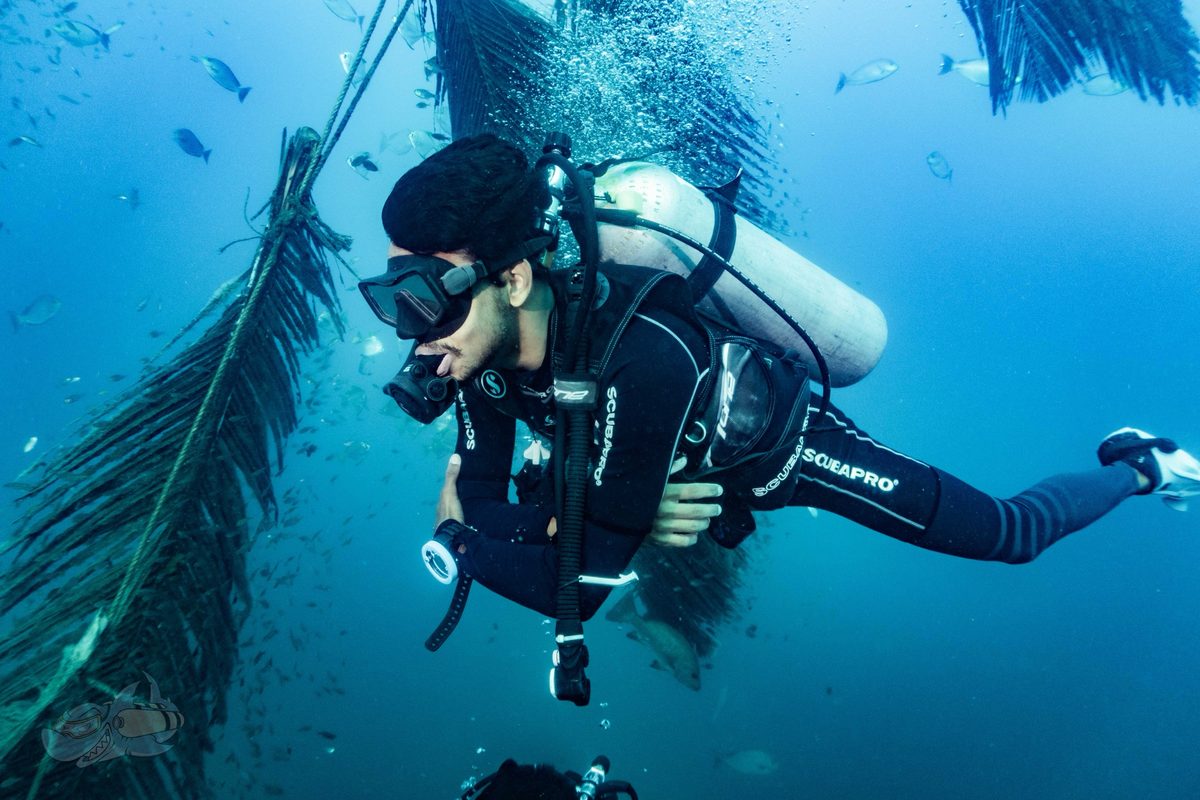
Going to 30m isn't just going deeper. The gas management changes. Narcosis becomes a real consideration. You're managing your no-decompression limit with less margin than at 18m.
- Controlled descent with buoyancy management at depth
- Narcosis awareness: understanding your own response and adjusting accordingly
- Gas management at depth, safety stop discipline, ascent rate control
Night diving
Night diving is one of the best diving experiences available. It's also where communication and buddy procedures actually matter, because you can't just look around.
- Torch techniques: primary and backup, signalling, underwater communication
- Buddy awareness and contact procedures in low visibility
- What changes at night and why it's worth doing
Buoyancy refinement
The pool session focuses specifically on buoyancy control, the skill that underpins everything else.
- Trim adjustment with different exposure suits and equipment
- Breath control for depth management
- Moving through water without stirring up the bottom
Course structure
4 days. More time is spent in the water than most Advanced courses, and the focus is on genuine skill development at each stage.
- Day 1: Pool session, buoyancy refinement, equipment familiarisation
- Day 2: Navigation and deep dives
- Day 3: Skills development dives
- Day 4: Night dive plus review and sign-off
- Maximum depth: 30 metres
- Ratio: 2 students per instructor maximum
Who teaches this course
Advanced Open Water is sometimes taught by Donarun personally, and sometimes by instructors he has trained, depending on scheduling and group size. Either way, the standard is the same. If you specifically want Donarun, mention it when you enquire.
Where we train
The Maldives, Sri Lanka, and India. Location confirmed when scheduling.
What comes next
Two directions from here:
- Rescue Diver: the course most divers say changed how they think about every dive they do afterwards
- Deep Diving Specialty: extend your skills and depth range to 40m with proper preparation
Frequently asked questions
Is this just five adventure dives and a card?
No. The dives are structured around skill development in each discipline. Navigation dives have navigation objectives. Deep dives include narcosis briefing and gas management practice. Night diving includes buddy procedure drills. You'll be working during the dives, not just enjoying them.
How many logged dives do I need?
A minimum of 10. Quality matters more than quantity. A diver with 10 careful, attentive dives will get more from this course than someone with 30 inattentive ones.
Is Advanced Open Water required for technical training?
It's a step on the pathway, not a destination. Advanced Open Water + Rescue Diver + solid fundamental skills is the standard recreational foundation before technical training begins.
Can I skip Advanced Open Water and go straight to technical?
Some technical agencies allow it, but the habits built in Advanced Open Water, deep diving awareness, navigation, night diving, are worth having before you add decompression planning and equipment complexity.
Enquire about training
Enquire here. Donarun responds personally to every enquiry.
Pricing
Pricing is tailored to your course, location, and schedule. A full breakdown is provided before any commitment is made.
Frequently asked questions
- What are the prerequisites for Advanced Open Water?
- No specific prerequisites; enquire directly to confirm the course suits your experience level.
- What certification do I receive after completing Advanced Open Water?
- You receive a PADI Advanced Open Water certification, recognised worldwide, upon successful completion.
- How long is the Advanced Open Water course?
- The Advanced Open Water course runs for 4 days.
- Where do you run this course?
- Courses run across the Maldives, Sri Lanka, and India (Pondicherry, Lakshadweep, and Meghalaya), scheduled around your dates and the right dive site for the course.
- How much does Advanced Open Water cost?
- Pricing is quoted individually, because dive centre fees, certification costs, and logistics vary by course, location, and schedule. You get a full breakdown before any commitment.
- Who teaches this course?
- Donarun Das, a TDI Trimix Instructor, KISS Sidewinder CCR Instructor, and PADI Staff Instructor teaching across the Maldives, Sri Lanka, and India, with 15+ years of diving experience and a mechanical engineering background from NIT Silchar.