Tec 45 / Advanced Nitrox & Decompression Procedures
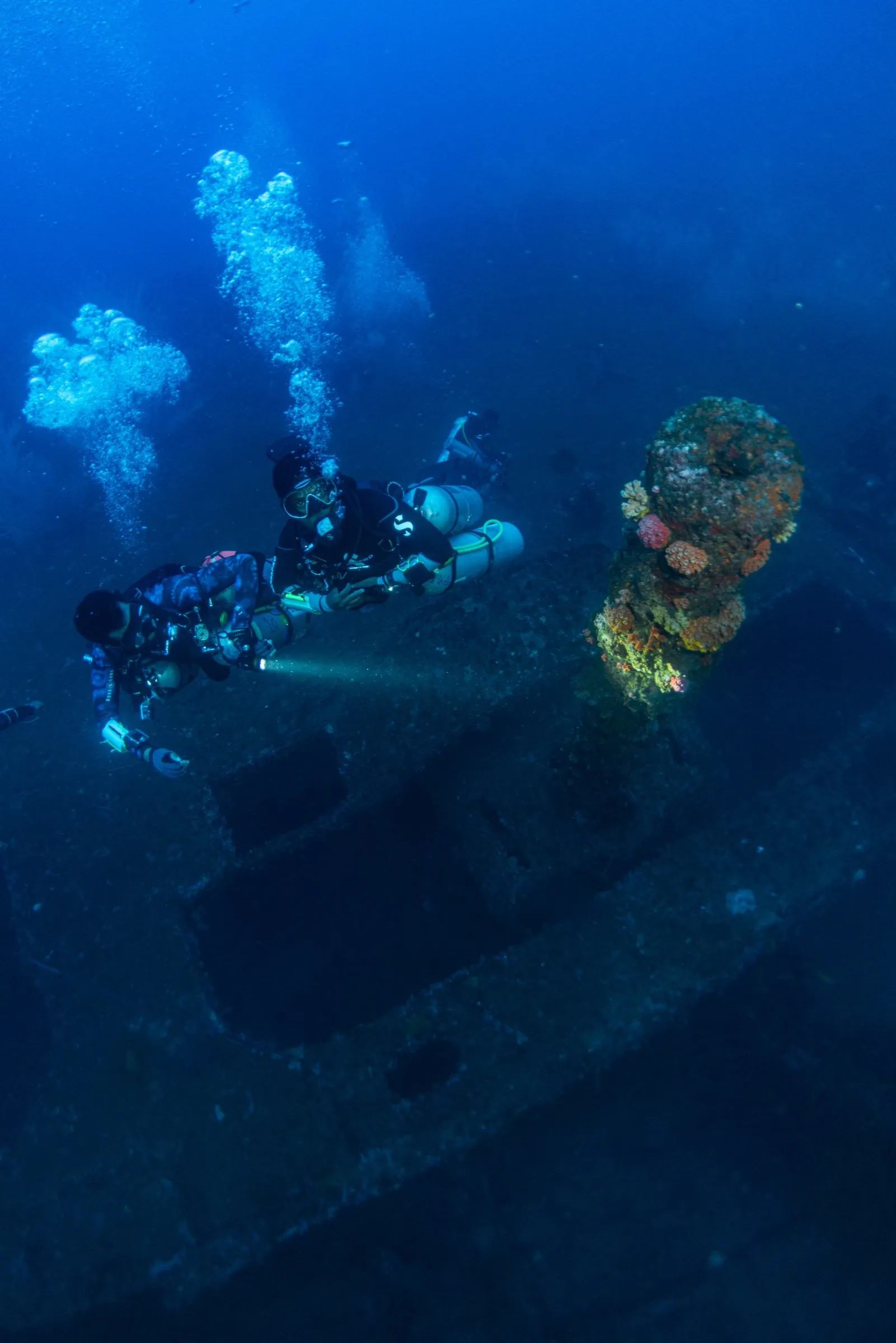
The course that takes away your exit
Recreational diving has one reliable emergency procedure: go up. Something goes wrong, you ascend.
Technical decompression diving takes that away. Once you've accumulated a decompression obligation, mandatory stop time in the water column, surfacing directly isn't a safe option anymore. You've created a physiological debt that has to be paid at specific depths before you can surface safely.
This is the course where that shift stops being theoretical. Tec 45 and TDI Advanced Nitrox & Decompression Procedures train you to plan dives that carry decompression obligations, execute the decompression correctly, and manage the moments when the plan changes mid-dive, all while the surface is no longer your immediate exit.
Most divers find this more psychologically demanding than they expected. That demand is exactly the point.
The difference between Tec 40 and here
The gap isn't time in the water. It's discipline standard. Gas tracking throughout the dive rather than at the end. Team awareness during ascent. Practiced failure responses that hold up when conditions aren't cooperative.
This course builds that standard through real diving, not classroom exercises. By the end of it, the responses aren't memorised procedures. They're habits.
What you'll learn
Decompression science, not just procedures
Most courses teach you what to do during decompression. This one teaches you why, so that when the situation changes, you understand the actual decision you're facing.
- Tissue compartment loading and off-gassing across a multi-gas profile
- Gradient factor selection: what adjusting it does to your tissues and your ascent curve
- Oxygen toxicity in real decompression context: CNS limits relative to workload, not just depth
- Isobaric counterdiffusion: the mechanism, when it's a genuine risk, and the gas-switch protocols that prevent it
- Why nitrox deco gas accelerates off-gassing, and when that benefit is physiologically real
- Managing decompression conservatism across a day of repetitive technical dives
Gas planning for two-gas deco profiles
- Planning with a primary back gas and one or two deco gases
- Rock-bottom calculation from first principles: the logic, not just the formula
- MOD management when a high-oxygen deco gas is on a stage cylinder
- Gas loss scenarios: what you do when the deco cylinder isn't available at the planned switch point
- CNS oxygen tracking across a full dive day
The CNS clock · build a two-dive day
Dive 1
Surface interval
Dive 2
—
100% is the recommended single-day exposure limit, not the moment you seize; most divers plan to stay under 80%. Notice how a real surface interval claws most of your budget back: the clock halves roughly every 90 minutes.
Equipment at this level
- Twinset or sidemount with one or two stage cylinders, trimmed and streamlined
- Stage cylinder mounting and buoyancy management at decompression depths
- Gas switch procedure: clean, reliable, practiced at the actual switch depth
- Valve shutdown under mild stress: the drill that shows whether buoyancy is genuinely solid
- Computer management: primary and backup, and what to do when they disagree
Decompression execution
- Ascent rate discipline from 40 to 45m with multiple stop depths
- Stop precision (depth and time) when there's current or limited visibility
- DSMB deployment from decompression depth: technique that works under load
- Managing buoyancy and trim during stationary stops without drifting
- Emergency decompression decisions when the plan changes and you need a new one
Failure scenarios, trained until automatic
Every scenario here gets drilled until the response doesn't require conscious effort:
- Loss of primary deco gas before the planned switch point
- Gas switch to a contaminated or mislabelled cylinder
- Computer failure during active decompression
- Narcosis at depth requiring an early ascent decision
- Unplanned additional decompression obligation
- Team separation during ascent
- DSMB tangle during a deco stop
Prerequisites
- Tec 40 / Intro to Tech or equivalent first-step technical certification
- 50+ logged dives
- Solid neutral buoyancy and trim with a stage cylinder attached
- Enriched Air Nitrox certification
- Comfortable carrying and switching a stage cylinder
Course duration
4 to 5 days, mastery-based. TDI Advanced Nitrox and Decompression Procedures are taught together, so you receive both certifications. PADI Tec 45 covers the same content as a single integrated course. There's no fixed daily checklist: you progress when the skills hold up under task loading.
Gear
- Twinset or sidemount
- One to two stage cylinders with regulators
- Long-hose primary configuration
- Two cutting tools
- Primary and backup lights
- Two DSMBs and spools
- Wrist slates and wetnotes
- Two decompression-capable dive computers
Gear hire is available with advance notice.
Training locations
Training runs across the Maldives, Sri Lanka, and India. Location matched to your goals and the conditions at the time of scheduling.
What comes next
- Tec 50 / Extended Range: deeper air-range diving with three gases and higher task loading
- Trimix 60 to 75m: where helium enters the planning
The theory behind the course
The depth notes go deeper on the science this course puts into practice:
Frequently asked questions
What's the actual difference between Tec 40 and Tec 45?
Tec 40 introduces limited decompression, up to 10 minutes total stops, as a bridge concept. Tec 45 is genuine staged decompression: multiple stops, multiple gases, real obligations that can't be shortened by an early ascent decision. The discipline standard and complexity are substantially higher.
TDI Advanced Nitrox and Decompression Procedures: one course or two?
Two TDI certifications almost always taught together. Advanced Nitrox covers oxygen-rich deco gas management. Decompression Procedures covers planned staged deco execution. Combined, they're the TDI equivalent of PADI Tec 45, and you leave with both cards.
Do I actually need two decompression gases at 45m?
Not always. Shallower dives with short bottom times may only need one. At 40 to 45m with run times over 40 minutes, two deco gases reduce total decompression time and CNS load meaningfully. The course teaches you to make that decision based on your actual dive plan.
What's the decompression obligation at 45m?
It depends on bottom time. A 20-minute bottom time at 40m might carry 5 to 10 minutes of total decompression. A 30-minute bottom time at 45m could carry 20 to 30 minutes. Planning that obligation, and managing it when the dive runs long, is what this course is about.
How physically demanding is it?
Carrying two stage cylinders is manageable once you've adjusted. The real demand is mental: gas tracking, team coordination, and staying composed across four to five full days of diving. Come rested.
Enquire about training
Enquire here. I answer every enquiry myself, whatever your timezone.
Pricing
Pricing is tailored to your course, location, and schedule. A full breakdown is provided before any commitment is made.
Frequently asked questions
- What are the prerequisites for Tec 45 / Advanced Nitrox & Decompression Procedures?
- No specific prerequisites; enquire directly to confirm the course suits your experience level.
- What certification do I receive after completing Tec 45 / Advanced Nitrox & Decompression Procedures?
- You receive a PADI / TDI Tec 45 / Advanced Nitrox & Decompression Procedures certification, recognised worldwide, upon successful completion.
- How long is the Tec 45 / Advanced Nitrox & Decompression Procedures course?
- The Tec 45 / Advanced Nitrox & Decompression Procedures course runs for 4 to 5 days.
- Where do you run this course?
- Courses run across the Maldives, Sri Lanka, and India (Pondicherry, Lakshadweep, and Meghalaya), scheduled around your dates and the right dive site for the course.
- How much does Tec 45 / Advanced Nitrox & Decompression Procedures cost?
- Pricing is quoted individually, because dive centre fees, certification costs, and logistics vary by course, location, and schedule. You get a full breakdown before any commitment.
- Who teaches this course?
- Donarun Das, a TDI Trimix Instructor, KISS Sidewinder CCR Instructor, and PADI Staff Instructor teaching across the Maldives, Sri Lanka, and India, with 15+ years of diving experience and a mechanical engineering background from NIT Silchar.